Jim Tyrer: Rethinking HOF candidacy
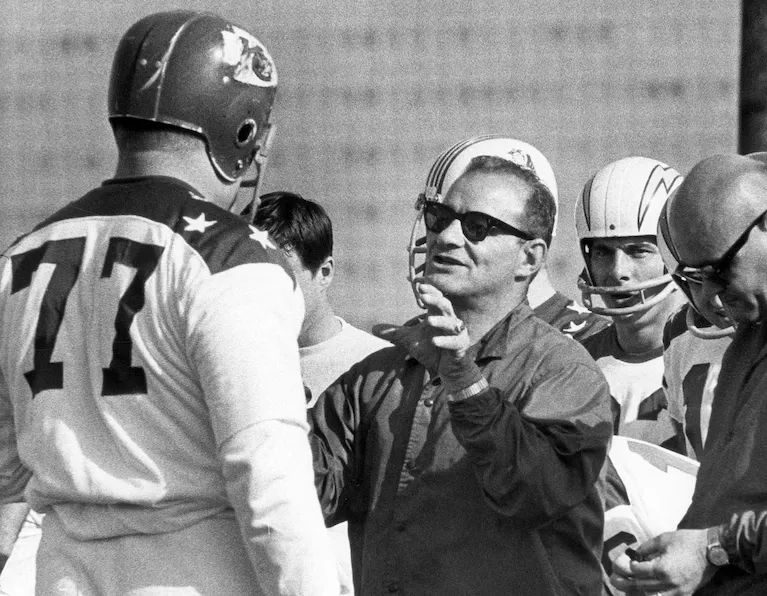
By almost all objective measurements, former Kansas City Chiefs offensive tackle Jim Tyrer is the most qualified senior candidate not in the Pro Football Hall of Fame. In about a week, if the HOFame’s new Senior Screening Committee includes him in its cut down to 50 candidates, it could be the first time in 43 years that the Senior Selection Committee might discuss his name.
Why is that?
In September of 1980, even as he was a finalist and potential first-ballot Hall of Famer, Tyrer killed his wife and himself. He was 41, and his wife, Martha, 40. They left four young children who were raised by her parents.
In the aftermath of that tragedy, Tyrer’s name made it no further in that 1980 HOFame debate, and although he was on some preliminary lists, he never again advanced enough to be discussed. Recently, there has been a groundswell of support for officially discussing Tyrer’s worthiness as a Hall of Famer.
Why is that?
It starts with Dr. Douglas Paone, an internist and diagnostician, who met with Tyrer on Sept. 12, 1980, two days before the murder-suicide, and scheduled a follow-up the next week as he tried to make sense of the symptoms.
After the horrible deaths, Dr. Paone was haunted by the tragedy and believed those symptoms had something to do with it.
Dr. Paone told me his story Sunday, which has nagged him all these years.
In June 2005, Dr. Paone was sitting on the side of his bed, pondering a top news item of the day. There were stories in the papers and on TV, as well as writings in medical journals. Then, it all coalesced in less than a second.
“It was like a light bulb went off in my head,” Dr. Paone recalled. “Oh my God, that’s what was happening to Jim. It was like somebody slapped me in the face. “
Dr. Paone, now an internist in Naples., Fla., double-checked all the documentation of his brief meeting back in 1980 and anything else he could find.
“In retrospect, his symptoms check all the boxes.” Dr. Paone said. “Based on his clinical presentation, his mental status, and his history of trauma, he was a perfect example of someone who had the syndrome.”
The syndrome is known as CTE—chronic traumatic encephalopathy—which was not recognized as a syndrome at the time. Dr. Paone knew there was something, but there wasn’t a word or known syndrome to explain it.
He was limited by a medical version of linguistic determinism, which has underlying similarities to Orwellian Newspeak: The theory that if a language does not have the means to express specific ideas, its speakers cannot conceptualize them.
We have learned that CTE is the debilitating, degenerative brain disease found in an ever-growing number of retired football players in recent years after their deaths. It is a disease that leads to depression, anger, impaired judgment, and volatile, irrational behavior. It is widely believed to be caused by the kind of repeated blows to the head that was an SOP for Tyrer and the men who played the violent game of football.
Tyrer, a team leader during the Chiefs' heyday of the 1960s, was having headaches and abdominal pain, but more significantly, he hadn’t been himself for a while.
Unable to pinpoint the problem, Paone asked the slumping and lethargic giant: “‘Jim, do you think you might have some depression?’ He said, ‘No, it’s more than that.’ But this was 1980. Brain trauma and (chronic traumatic encephalopathy) weren’t understood then.”
But after all his homework, Dr. Paone made this blunt assessment a few years back.
“He had CTE. No doubt in my mind,” the doctor said of Tyrer. “You couldn’t even pick a person that had a better presentation of the disease. As an internist, I have to make diagnoses without slides and without scans. If it walks like a duck, quacks, water runs off its back and its name is Daffy. It’s not a zebra. He had CTE.”
Many now say it is ironic that he is being banned from the Pro Football Hall of Fame because of something football did to him.
And why is that?
Again, Tyrer was a first-ballot finalist for the Hall of Fame at the time of the murder-suicide. Although the rules of the Hall of Fame are completely confined to the football field, his name never again appeared on the ballot. Chris Nowinski, CEO of the Concussion Legacy Foundation said, “I cannot imagine that they would want to even entertain the thought that you could forgive somebody for that act because it was actually football that changed his brain, changed his behavior and played a role in what happened.”
Considerations such as that are why Tyrer has a chance to be discussed by the Hall of Fame selection committee for the first time since 1980.
Here are some of Tyrer’s football credentials that will be acknowledged:
—8× All-AFL (1962–1969)
—7× AFL All-Star (1962–1966, 1968, 1969)
—2× Pro Bowl (1970, 1971)
—First-team All-Pro (1970)
—3× AFL champion (1962, 1966, 1969)
—Super Bowl champion (IV)
—AFL All-Time Team (essentially AFL 1960s All-Decade Team)
—Kansas City Chiefs Hall of Fame
Many consider him one of the greatest players in AFL history. His story's football side is compelling, and his final actions are concerning.
Different time, different game
In the 1960s, offensive linemen could not legally hold as they can today. Instead, they were told to lead with their heads, becoming a human battering ram. Tyrer had the largest head in pro football. His helmet was custom-made and apparently not very well. His children kept the helmet and said it was only about a half-inch thick with nothing to absorb shock.
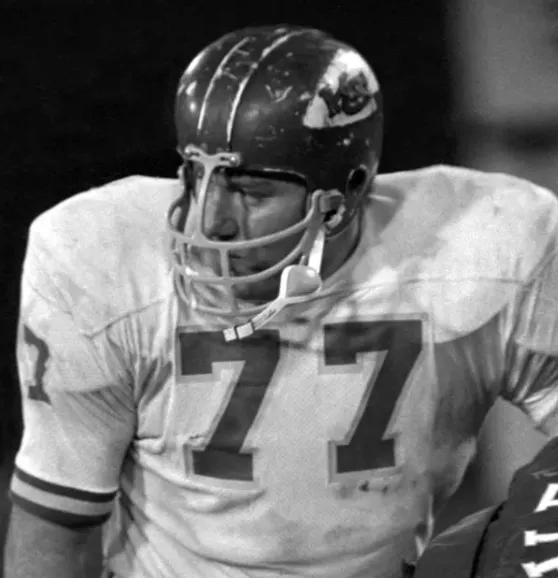
To combat offensive linemen, defensive linemen were allowed to head slap, crashing their forearms into the side of a lineman’s helmet while often pushing their fist up into their facemasks, driving their necks back violently.
Did that lead to the kind of brain damage that also felled Junior Seau, Mike Webster and so many others, as we now know? For Jim Tyrer, it’s far too late to tell, but one could certainly theorize it well might have been. Dr. Paone is certain.
Fellow Senior Selector Ron Borges recently wrote about the Tyrer dilemma, some of which we summarize here:
Kansas City Hall of Fame coach Hank Stram: “If you could pick a prototype out of a Sears, Roebuck catalogue, Jim Tyrer would be it,’’ Stram said of Tyrer, whose roster measurements were 6-7, 290.
“It is a travesty that Jim Tyrer has yet to be inducted into Canton," ex-Broncos' pass rusher and All-AFL selection Rich Jackson once said. "He was one of the first big offensive linemen with quick feet to play pro football. Besides having good feet, he was crafty and smart. Tyrer was the top offensive lineman I ever faced, and that included the AFL and NFL."
Does such a player belong in Canton? It would seem so. Does such a man whose life ended in violent tragedy belong? That is a difficult call, but as we learn more about the ravages of concussions and CTE and their debilitating effects on many ex-football players it is a question we need to ask.
According to the bylaws of the Pro Football Hall of Fame, which excludes off-field matters by fiat, it would seem a debate over Jim Tyrer is long overdue. According to his resume alone, it wouldn’t seem to be much of a debate that his play long ago earned him a bust in Canton.
But if the Screening Committee includes him on the cut to 50, there probably will be a lot of debate. There are nine selectors on the Senior Blue Ribbon committee, which can nominate up to three senior players to be considered by the full, 50-person selection committee.
It is impossible to predict Tyrer’s fate. We know some selectors may not vote for him because of religious beliefs that condemn suicide. Others are purists who will only consider his play on the football field, per HOF guidelines.
Some may question whether his accomplishments in the old AFL should be devalued rather than fully embraced. I believe those who still hold on to that perspective didn’t watch enough of the AFL. We will revisit that issue in other parts of this series on selecting the Pro Football Hall of Fame’s 2025 Class.
Ultimately, the selectors will do what they believe is correct, which will be a personal decision.
What would you do?